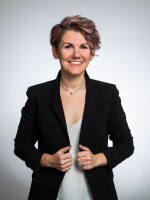
In this episode, hosts Eric Fey and Brianna Lennon speak with Michelle Kavanaugh, the Bernalillo County Clerk in New Mexico.
They spoke about some of the recent changes to New Mexican election law, which include automatic voter registration at the Motor Vehicle Division, semi-open primaries and the restoration of voting rights to citizens after incarceration — regardless of felony status.
High Turnout, Wide Margins Credits:
Managing Editor: Rebecca Smith
Managing Producer: Aaron Hay
Associate Producer: Katie Quinn
Digital Producer: Mark Johnson
Transcription of the episode is as follows:
Michelle Kavanaugh: If you've been released and you are expected to be a productive member of society, you know, let's get you productive. Let's have you contributing to your community. When you are helping make decisions to better your community, for your family, for your neighbor, for your fellow human, isn't that something that is going to make you feel better about participating in that society in other ways? Of course, it is. So let's get you voting. Let's get you participating. Let's get you really, really engaging.
[High Turnout Wide Margins Introduction]
Eric Fey: All right, everybody. Welcome back to another exciting episode of High Turnout Wide Margins. I am Eric Fey, Director of Elections in St. Louis County, Missouri. With my co-host —
Brianna Lennon: Brianna Lennon, County Clerk in Boone County, Missouri.
Eric Fey: And today our guest is —
Michelle Kavanaugh: Michelle Kavanaugh, County Clerk, Bernalillo County, New Mexico.
Eric Fey: So, you are our first New Mexican on the podcast where we just have a couple states left to cross off the list. This is very exciting for us. Our first question with every guest is: How did you get into elections? What's your election origin story?
Michelle Kavanaugh: How much time do you have? That is only kind of a joke because I do tend to ramble, but I grew up in politics. My parents are public servants, as they say. My mom was a teacher for 20 years, and my dad was an attorney and later a judge. So, my dad was campaigning when I was a kid. I was out there on the sidewalk holding signs for him, as a kid. My mom ran for state senate and state school board and then state representative. She actually did end up winning — that was when I was an adult. She was the American Federation of Teachers President for several years and then the first female Latina New Mexico Federation of Labor President. They were the state arm of the AFL-CIO [American Federation of Labor and Congress of Industrial Organizations]. I have politics in the blood. I have labor in the blood and I have campaigning in the blood.
I was on the campaign side for many, many, many, many, many years. I think organizing really, ultimately, is in the blood and is my passion. I was an organizer for AFT [American Federation of Teachers] New Mexico for a while. I was an organizer for Working America, and I don't know if you guys know what that is, but they were basically the working people arm of the AFL-CIO. Anybody who didn't fit into, like, a traditional labor union could join Working America and kind of all band together to fight for the same things that traditional union members could fight for, kind of more on a global scale. Everybody deserves breaks and weekends and all the same sorts of things. And just because you aren't a teacher or a firefighter or a plumber doesn't mean that you shouldn't be able to join together and use your collective power. So anyway, I did that.
I also worked, volunteered for Rock the Vote when I was a little baby of 18, 19, 20, and was in love with Tom Morello, which was a big help. And so, I was the kind of person also who said, "If you don't vote, don't complain," and "Stop whining about things if you can't even be bothered." As I've grown up and learned a little bit more and matured, I've come to realize that it's not really that simple. There are lots of reasons why people don't vote. I realized that, like I said, it's not that simple, there's a lot more to it than just not caring. One of my goals now as the county clerk is to address those reasons.
Then, I worked for several years as a field representative for our senior senator, US Senator Tom Udall in New Mexico. Who later became, after he retired, the US ambassador to New Zealand and American Samoa, and, as a Lord of the Rings fan, that was very exciting. I planned to spend most of my time down there. And then, he went and left when Joe Biden was no longer president, and I never got to go. So, that is very, very sad.
Brianna Lennon: So, he owes you a trip.
Michelle Kavanaugh: He owes me a trip to New Zealand. Absolutely, absolutely. Through my work, through Tom Udall, I was able to connect with a lot of people who I had maintained contact with, you know, through my entire life, there are all these people who I made contact with, through labor, through Democratic party politics, through all of these different roles that I'm so lucky to have had.
I made all these contacts, and the then county clerk said, "Hey, I have a great idea for you, you know, your boss, Tom Udall, is retiring. Come be my deputy." So, I became the deputy county clerk in Bernalillo County, and I did that for four years. She said, "You should really think about running. I think it would be great for you." And I said, "Not a chance in heck. I think that is a terrible idea. I'm a behind-the-scenes person." Then, as time got closer and closer, I said, "Well, you know, it's actually not the worst idea. I love the job and voting is my passion. I think it's a great, noble idea."
So, eventually she broke me and running for office was the worst thing I've ever done in my entire life, not being a particularly outgoing person. It was really really hard, but I did win, and now I'm the clerk. I have had the chance to really implement a lot of cool ideas. So, I love it. I love doing the job. The idea of having to run again in two years is terrifying, but I'll do it because I'm not done.
Brianna Lennon: So, can you just for, I think, context and frame of reference, explain your county, how large it is, the major cities that are in it, and things like that.
We are at PLEJ, I don't think we mentioned that earlier, which is a conference in Fort Lauderdale, where the convening is mostly of larger election jurisdictions.
Michelle Kavanaugh: So, Bernalillo County is the largest county in New Mexico and we have over 600,000 people who live there. The amount of registered voters is about 400 and some thousand. The amount of people who actually vote in any given year is about 400,000. Albuquerque is the city, the main city, in Bernalillo County. There's a lot of little, tiny communities that make up the rest of Bernalillo County and a lot of unincorporated area.
There is a town of Bernalillo that is not located in Bernalillo County, that's actually located in Sandoval County, not Bernalillo County.
One of the frustrating things, kind of, about Bernalillo County is that being so big in, kind of, a sea of really rural counties, there aren't a lot of places in New Mexico that share some of the struggles that we have and some of the issues that we face. So, it's really nice being able to come to a conference like PLEJ where other large jurisdictions can commiserate or brainstorm or kind of talk about the issues that we face. And so, it's really neat being able to come here and talk to other places about some of the issues that we face.
Eric Fey: And just— I know the job is multifaceted — but just in a synopsis, what do county clerks in New Mexico do? What are you responsible for in your role?
Michelle Kavanaugh: Sure. So, across the country, you know, clerks, clerk recorders, and recorders — they're called different things. They do different things. In New Mexico, county clerks — There are 33 counties in New Mexico. We tend to have two sides in each of our offices. Now, on one side we have recording and filing. And, on that side, we issue marriage licenses. We also do property filing, recording of deeds, recording of whatever somebody chooses to file. We will record just about anything you could possibly want as long as you pay a $25 fee, we will record it for you.
We have people recording sovereign citizen documents and divorce decrees, and just whatever people want to file, we will file it for them. Real estate documents, warranty deeds and liens, and that sort of thing. Lots and lots of real estate documents. Like I said, marriage licenses, we do probably the most of on that side of the house.
And then, we have a Bureau of Elections, and that's kind of the sexy side of the clerk's office. The side that gets the most attention, really. Although, I would say that the recording and filing side is really the busier side throughout the year. They really don't ever slow down. But elections is the attention getter, really, of the two. We run the election. We run statewide elections, general elections, municipal elections, special elections.
In New Mexico, municipalities can choose to opt in to have the counties run their elections. So, cities can say, "We would really like the county to run our election. We are wiping our hands of it. We don't want to deal with it. Can the county run this election for us?" Not all of them do. There are some who say, "We really want to keep this close to the vest."
Another kind of big city, the city of Rio Rancho, is in Sandoval County. I think that they have, for years and years and years, done it themselves. I believe that I heard that this year is the first year in, I think, 40 years of their incorporation, that they are opting to have Sandoval County run their election. So, good for them. It's a little more work for Sandoval County. But, you know, I think Sandoval County has the resources, or the counties have the resources, the experience, and kind of the manpower to do it, and it frees up, you know, the municipality to do other things because everybody's super busy.
Eric Fey: Do they have to pay you all to run those elections?
Michelle Kavanaugh: Sure do. Yes, they do. What will happen is the municipality will pay us, and we've got to pay for our temps, we got to pay for our equipment, we got to pay for all of that good stuff. And then, usually the state will then reimburse us for a lot of those expenses, as well.
[High Turnout Wide Margins Midbreak]
Brianna Lennon: Speaking of the structure of elections there's— and we've kind of touched on it in conversations before recording — there have been a ton of reforms that have really opened up a lot of things in New Mexico, which I think is it's fascinating anyway just from the perspective of there's not that many reforms happening right now that open things up and have granted automatic rights back to felons and moved primaries to a more open status. So, I'm wondering —it's probably a two part question, and you can pick whichever part you want to answer, but what's driving some of this election reform and also, what impact is it going to have on your office?
Michelle Kavanaugh: Sure, those are both really great questions. We're really lucky. New Mexico is a really progressive state. We have a Democratic governor. Our legislature is majority Democrat on both the Senate and the House sides. And our delegation, our federal delegation, is all five members are Democratic, and all of our Congresswomen are women. We have our — well, our two senators are men, but they're both pretty progressive. We've focused quite a bit in the last several years on early childhood education, on prison reform, on mental health care reform, behavioral health care.
We're really, as a state, focusing on how to overcome a lot of the generational struggles and cyclical issues that we have had as a state. There is a lot of poverty in New Mexico. There are a lot of generational issues that we are having to overcome. You know, we're a minority majority state. We have multiple pueblos and reservation land. We're very isolated with the mountains, so there's a lot of poverty. And so, luckily, with this progressive population in our elected leadership, they're really working on making good policy, and so, I think that what's happening is bleeding into all areas of legislation — including election legislation.
So, this last year, we have passed semi-open primaries, which is very exciting. What's really cool is that it doesn't actually affect anything until July of 2026. So, we have a full 18 months, really, to develop it, to make it look right, to make it work right, and to really get those details down solidly. We have a good amount of time to plan and make it work right before we actually have to implement it.
We have automatic voter registration through the Motor Vehicle Division. I think most places call it DMV. We call it MVD because we're New Mexico, we got to do it a little different. So, folks are automatically registered to vote when they get their driver's license or go in and renew their information. If they don't want to be automatically registered, they have to opt out. It's not an opt in, it's an opt out. So, they get mailed a card later where they have to actually put in the work and say, "I don't actually want that. I'm going to opt out of this." And they have to, you know, work to say, "I don't want to be registered." We're putting the onus on them to say that "I don't want to participate in this democracy." That's another really neat thing.
And like you were saying, we also are allowing felons who have been released from incarceration the ability to vote after they've been released. That one has a couple of extra steps that we're having to figure out logistically, but they're being allowed to vote once they've been released, which is hugely important. These reforms are so important, and people shouldn't be defined by the worst mistake that they've ever made in their lives. None of us should be defined that way. If you've paid your debt to society, you shouldn't be punished for that for the rest of your life.
If you've been released and you are expected to be a productive member of society, let's get you productive. Let's have you contributing to your community. When you are helping make decisions to better your community, for your family, for your neighbor, for your fellow human, isn't that something that is going to make you feel better about participating in that society in other ways? Of course, it is. So, let's get you voting. Let's get you participating. Let's get you really, really engaging.
Brianna Lennon: Speaking of public perception, I want to go back for a second to the open primary, semi-open primary. Missouri is a — we don't have mandatory party affiliation on our voter registration, which is unusual. I think if you're going to have party affiliation, you're either going to require it or not. And I have read things about one of the reasons New Mexico's somewhat open primary has come into play is because there are so many people that are choosing to be affiliated as independent or not affiliated at all, which I think is something that bears out in Missouri, too.
What if any, I guess, public perception have you felt in your role of whether people are kind of stepping back from wanting to be kind of affiliated with any party at all? Have you heard that from voters? Have you heard that people have been updating their registration to be unaffiliated, or they just don't have any interest?
Michelle Kavanaugh: Oh, God. Yes.
Brianna Lennon: I don't know if that has changed your actual, like, practices for things, but what have you felt from hearing that?
Michelle Kavanaugh: Yeah, absolutely. It seems like every year we're seeing it go up and up and up. I couldn't tell you exactly what the number is right now, but we are seeing major increase in the number of independent voters, decline to states. And people always ask me, "What do you think is the reason for the decline to states increasing so much?" Because it's a pretty substantial increase year over year. We're seeing it more on the Democrat side, quite honestly. And there are a lot of reasons for it, and I can only speculate, but I don't know if I should.
Laughter
But folks' confidence in the political parties, that's not news to anybody. Folks have trust issues with their parties, and I don't know — there's so many reasons. There's so many reasons.
Brianna Lennon: I think it's really interesting that the legislation took that into account, I guess, the elections administration infrastructure as a whole depends on there being, in most states, a two party system. You have to have Republicans and Democrats at polling places. You have to have bipartisanship. And when we're seeing people that are no longer wanting to be affiliated with either of those, it has a lasting impact on how elections administration happens.
So, for an outsider looking at New Mexico opening up primaries — seems like a positive recognition that, "Hey, we can't keep doing what we're doing and still getting everybody to participate because if they're choosing not to affiliate, we have to come up with a way for them to be able to vote." And they recognized that and made that difference, which I think is unique. There's not a lot of states that are taking that into account, like the practicalities of it. So, have you heard, I guess, from some of those voters, that they are happy that they're no longer going to have to be in a closed primary situation?
Michelle Kavanaugh: They're extremely happy. The process before was that those independent voters were having to change their political party immediately before the primary, and then they could change it right back after the primary passed and after the books had reopened. That was a pain in the butt for them. And so, this, obviously, will remove some of that legwork for them, which in turn will increase their participation. We definitely see that as a good thing, although the folks who are independent, I think, are generally going to be more inclined to participate anyway. So, they're very excited. They're very excited.
I've gotten a lot of calls recently from folks who are very curious as to how it's going to work, and with people who are now going to be on the permanent absentee list — which is also a new thing — they're wondering, "Well, how is that going to work, and what ballot am I going to get sent? And how do you know which one I'm going to want? And when is that going to get decided, and when are those going to be mailed out?" That's some of the stuff that we're trying to work through right now and discuss with the Secretary of State.
So, again, we're really lucky that we have some time before we have to really have all of that decided. And I really hope that this helps drive participation for you know, your 18 to 30s, because their participation, right now, is pretty dismal, and not that that's anything new. I mean, I was with Rock the Vote in 1998 to 2001 and that was our goal then, was getting people to vote. That's why they were created because young people weren't voting, and we're still facing the same issue.
Eric Fey: You've been listening to High Turnout Wide Margins, a podcast that explores local elections administration. I'm your host, Eric Fey, alongside Brianna Lennon. A big thanks to KBIA and the Election Center for making this podcast possible. Our Managing Editor is Rebecca Smith. Managing Producer is Aaron Hay. Our Associate Producer is Katie Quinn, and our Digital Producer is Mark Johnson. This has been High Turnout Wide Margins. Thanks for listening.