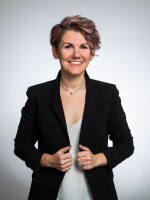
In this episode, hosts Eric Fey and Brianna Lennon speak with Bill Gates. He’s the director of Arizona State University Mechanics of De mocracy Lab, as well as the former chairman of the Maricopa County Board of Supervisors in Arizona.
They spoke about AI in elections — Both how generative AI tools could be responsibly used in election offices and how election officials might combat bad actors spreading mis- and disinformation through AI deep fakes.
You can learn more about the Mechanics of Democracy Lab at https://modl.spa.asu.edu/
High Turnout, Wide Margins Credits:
Managing Editor: Rebecca Smith
Managing Producer: Aaron Hay
Associate Producer: Katie Quinn
Digital Producer: Mark Johnson
Transcription of the episode is as follows:
Bill Gates: People are using AI on their phones to do meal planning or to plan their vacation or whatever, or learn whatever the newest of volleyball moves are — whatever the case may be. So, instead, as opposed to just saying, "Come on IT depart[ment], you guys need to lighten up, right?" That's probably not the right approach. Instead, say, "Here is a model AI use policy. Take a look at this. This is something they're using in other counties. This is something where our employees can learn how to use this effectively, how to do it safely."
[High Turnout Wide Margins Introduction]
Eric Fey: Okay, everybody welcome to another exciting episode of High Turnout Wide Margins. I am Eric Fey, Director of Elections in St. Louis County, Missouri, and I'm here with my co-host —
Brianna Lennon: Brianna Lennon, County Clerk in Boone County, Missouri.
Eric Fey: And our guest today is —
Bill Gates: Bill Gates from Arizona State University.
Eric Fey: So, we don't normally have people from universities on the podcast, Bill, but you are not just with the university. You have a track record in elections, and our first question on every podcast for the guest is, how did you get involved in elections? What's your election origin story?
Bill Gates: So, my origin story started in 2002. I was in my late 20s, and I was recruited by the Arizona Republican Party to serve as an election observer in one of the out counties — actually Navajo County in Arizona, and so, I got the call literally the day before the election. "Hey, can you hop in the car? Four hour drive and do election observing? We have a very close congressional race up there." I said — called my wife. We had a brand new baby. I'm like, "Do you mind if I go do this?" She's like, "Absolutely, go for it." And then I was like, "Oh, I have no idea what I'm doing." And they said, "That's fine." Now, I didn't have a cell phone yet, so I pulled off on the drive up there in Flagstaff and got on a pay phone at a Circle K and the guys from the RNC walked me through, gave me the details. And the next day, did it, loved it, and actually was up all night long. And then, did it again in ‘04, and then in '06 and '08, I ran the state program for the Arizona Republican Party. And then, I got away from it — I got away from elections. I was elected to the Phoenix City Council, and then I got elected to the Maricopa County Board of Supervisors in 2016, which shares responsibility for elections with the Maricopa County Recorder, and got a little involved in elections again.
Laughter
Brianna Lennon: So, I do want to note that this is an interesting episode, because we're at Washington University in St. Louis, and we're here because we were talking about AI and how AI can be used — especially in the election space. That was [what] you came to talk about. You're working on that right now. Can you talk a little bit about what your current project is and why you think it's important, especially now, given your experiences in the Maricopa election world.
Bill Gates: Yes, so in 2024 I decided not to run for reelection, and instead went to Arizona State University, where I'm a professor of practice, but I've also started what we call the Mechanics of Democracy Laboratory. So, we provide — we help support current elections officials. We provide them with resources. We host convenings. We have a fellowship program. So, we're helping to train the next generation of elections officials, both graduate students and undergraduate students. But another thing — and this was not on my bingo card when I went over there, we started an AI and elections clinic at the behest of the Arizona Secretary of State, Adrian Fontes, who had created a committee and said, "Hey, Bill, this will be a good idea for you to do this."
And it has just been awesome. We've had so much support. We have Microsoft as one of our partners in this program, we have the Elections Group, which is a very well known nonprofit with lots of experience in elections, who works very closely with us. And so, what we're doing is we are working with elections officials to kind of expose them to AI, you know, some of them are quite sophisticated that others are not. So, we're spending time with them, giving them the basics — like teaching them about the different AI tools, and then this is kind of culminating with a series of boot camps we're going to start. The first one's going to be in November, where we'll have elections officials coming in, spending a day in a room with, actually, the Chief Information Security Officer for the Arizona Secretary of State's office, Michael Moore, is going to be running this.
They're going to — the elections officials are going to spend the day with their fingers on keyboards, you know, learning the tools, running through scenarios and seeing what can be done. And so, with this convening happening here at WashU, this was a wonderful opportunity to tell people about what we're doing at ASU, and then find out the other great work that people are doing in this space across the country.
Eric Fey: So, as you know, election officials have the opportunity to attend conferences across the country from time to time. And it's a lot of sitting there listening to somebody talk about some topic which has its benefits, but you just made the point that this is purposely a hands on experience for election officials. You said you have a series of boot camps. So, I guess — because election people are very micro people — how are you getting people to come? Is the audience initially just Arizona election officials? Are you hoping for this to be a more expansive outlook in the future to folks across the country?
Bill Gates: Yeah, this is definitely nationwide in focus. We do have kind of a heavy emphasis on this first one on Arizona folks because it's being held in Arizona, and also, we want to kind of test out some stuff, but we do have some other national folks coming in. Then, we're going to do — and so, that's November 20. Then, we're doing one December 2nd in Washington, DC because ASU just happens to have a campus in DC. Then we're thinking spring training, you know, for the, let's see the Royals play in Arizona, right? So, for the Royals fans, you know, they can come out for spring training in a boot camp. And then, I think we'll also do one in Chicago because we're partnered as well with the University of Chicago and with Georgetown, too. So, we definitely want this to be national in scope, just because that's kind of ASU knows, no boundaries. That's just an ASU thing. But also, what we're doing, it's not like these trainings are dependent upon state election laws. I mean, these are broader principles. I really think that it can apply to elections officials across the country.
And, for me, I learned so much, you know, I'm not an AI expert, but I learned so much. Every time we meet with an elections official or talk to them, they're like, "Oh, here's what I'm thinking. Here's how either I'm using AI or I'm thinking about using AI." That's exciting. All the while, of course, we’re very much focused on safety, you know, doing this in a safe way, doing it in a way that we're not having any sensitive information or data out there. Obviously, elections officials are very attuned to that. But with the AI, frankly, we can get a little excited sometimes, and so, we always do bring it back to, “Hey, let's make sure we're working within the appropriate guardrails.”
Brianna Lennon: I know one of the maybe obstacles, if there's an election official that wants to get involved and wants to learn more about AI — some of the obstacles are navigating through that with their own county or their own jurisdiction. Trying to create a way to do it responsibly, like you said. But in cases, you know, we've worked through, over the years — election officials in the cybersecurity space, election officials getting more technologically involved. Not every IT department is excited about that. Not everybody has an IT department. I'm wondering if you can talk a little bit about advice, maybe, that you have for election officials navigating that as they're trying to work with their colleagues that are not election officials and may be more apt to say, "Oh, it's still too new. We don't want to do it. You can't do it." Because it came up today at the conference, that people probably do it anyway. It would be better have some policies and guardrails.
Bill Gates: Yeah no, that's right. I was actually kind of surprised, once I get into this work, how many counties are not allowing their input — not just elections, I'm talking generally, not allowing their employees to use AI in the office. And so, like you said, people are going to, you know, people are resourceful. People are using AI in their phones to do meal planning or to plan their vacation or whatever, or learn whatever the newest of volleyball moves are. Whatever the case may be. So, instead, as opposed to just saying, "Come on IT depart[ment], you guys need to lighten up, right?" That's probably not the right approach. Instead, say, "Here is a model AI use policy. Take a look at this. This is something they're using in other counties. This is something where our employees can learn how to use this effectively, how to do it safely."
We're even working on — we're playing on a little AI generated video that could be provided to employees because, again, you provide employees this sort of boring two page AI use policy, are they really going to read that? But if it's an AI generated video, they might do it because we — you're smiling, right? We kind of like to laugh at it. Oh, look at, you know, what they're doing. But hey, if it gets people to look at it, if it gets them to understand, "Oh, okay, you know, I need to use this tool. And this is the kind of information I can put in this tool. And, you know, this other one might do it in a different way." So, this is a big issue.
But here's the thing, I think that this is where, for the elections officials that are kind of challenged by a difficult IT department — go and get allies, right? Maybe the, whatever it is in your jurisdiction — the treasurer's office or the county recorder or whatever it might be — maybe they want to use AI too? And so, you can kind of get other allies and then make that case to the IT department as to why they need to open things up a little bit. Because if they don't do it, people are just going to go on their personal devices. I'm sorry they are.
Eric Fey: So, with this training being, or these symposiums, being kind of a hands on experience for election officials — just in the panel that immediately preceded our taping, your buddy, Stephen Richer, was making the point that election officials are pretty gun shy about AI because of all the doomsday stuff that you know was said about in the lead up to the 2024 election. What are some of the use cases? What are some of the things you are hoping to actually show election officials how to use AI for?
Bill Gates: Yeah, well, there's many. I think one is in the communication space — very big. Basically starting a communications plan, like putting that together, what that looks like. In particular, creating social media posts, and not just in one platform, like, AI can do it, and you name it, as many social media platforms as there are out there. I think that that's very helpful.
We know that elections involves a lot of logistics, so AI can have the ability to help us to become more efficient in those logistics, more efficient and effective in where we're placing, you know, polling places, vote centers.
We know that there are a lot of people, a lot [of] new, you know, rookie state legislators who they want to make their name by filing a bunch of bills, you know, election reform bills. Those bills all come out, and the first thing the media wants to do is go over and ask the elections director what she thinks of the 100 bills that just got dropped on elections, you know, most people don't have that time, like no one does. But AI is so good at summarizing, can provide summaries, so that the elections director can speak intelligently about that. I think that there are great opportunities with chatbots.
For example, you have certain, either you have small jurisdictions where they have very few people that answer the phone to take a live phone call, or in the larger jurisdictions, there can be issues that come up that just overwhelm the call center. But with a chatbot, well trained, has to be trained on the facts — a well trained chat bot can answer an infinite number of phone calls, bringing those wait times down, you know, the examples just go on and on.
Another one that's a big one is for a poll worker training, you know, [it] can assist with that. Let's say you've got a poll worker manual that's kind of dry. AI like that can turn it into an interesting PowerPoint presentation.
So, it's really you — there are as many use cases as your imagination can dream up. But what we don't — what we're not looking for — we're not looking for AI to tabulate the votes. Even, you get into jurisdictions that have signature verification. That's pretty much kind of leading edge stuff. So, I think there are plenty of use cases that are non-controversial, that we found elections officials are really interested in and maybe are using already.
[High Turnout Wide Margins Midbreak]
Brianna Lennon: When we're talking about communications, and one of the other things that came up at this conference earlier was the concern, and I guess not always concern, but the likelihood that there's going to be more deep fakes and AI-generated content for things like commercials and media. I think a lot of election officials are concerned about what that's going to do as calls flood into their office or disinformation. And there were a few studies today, that were brought up, that said that, kind of, the more that you had acknowledgement, I guess, that there were deep fakes and things like that, the less likely it was for somebody to participate even in the election. It didn't necessarily change minds about who you would vote for, but the concept that AI was involved in this made it a little less likely that somebody would even participate.
I'm wondering what we can do as election officials, and what your thoughts are on countering that, because I could definitely see voters saying, "You know, this whole thing just turns me off." And yeah, the AI that we're doing behind-the-scenes that makes their jobs more efficient, that's great that we're using that. But the AI that the consumers sees is more about the election itself and the candidates themselves, and if they get turned off, is there something that we can do to try to help with that?
Bill Gates: Yeah, I mean, it's a great question. To me, it is just another form of, kind of, the myths and disinformation that we've been dealing with for years. It's not really that different, other than just the the sort of multiplier effect because of AI because in the way that it can make things efficient in a positive way, it can also make the spreading of bad information efficient as well.
What we always did at Maricopa County, we always combated misinformation with more facts, you know that’s what we would do, and AI — so, I think the way you deal with AI is you throw AI at it, right? You put the positive AI at it. You can use it then to force multiply, getting the truth out there.
But this issue of these deep fakes, I mean, as you know, in 2024 we were all freaked out that these deep fakes were going to overwhelm us in elections. It didn't happen. I'm knocking on wood here. And instead, it was, you know, what we saw were the good old fashioned bomb threats, unfortunately. So, sort of the low tech scenario. We never really know what's going to come at us. All that we can do is, I think, continue to educate people. And more and more what's coming out of these meetings that I'm in is we need to focus on digital literacy, you know, we need to educate people because that has benefits beyond just elections, of course, in general, making it less likely that people are going to be scammed by a deep fake.
So, we need to really start focusing on this because we all believe in the First Amendment, you know, there isn't some solution where we can just stop those deep fakes. I mean, the First Amendment makes that very difficult. So, instead of going in that direction, there are some states that have gone with disclosure laws and things like that. “This is actually AI generated.” So, I think all of those things need to be on the table, but thinking that we can just silence and wish and snap our fingers and these deep fakes are going to go away — it's not going to happen.
Eric Fey: So Bill, I know, and I guess probably everybody listening to this podcast knows, that Maricopa County was the epicenter of — I don't even know what you would call it after the 2020 election — conspiracy, denialism. You and Stephen and other officials in Maricopa County really were put through the ringer after that election. In this context of what we're talking about here with AI and the tools that are available for election officials now. Do you think there's anything that we're at the forefront now of that would have helped you guys in 2020 or 2021?
Bill Gates: Well, I think it's just to the extent that it would allow — because it is effective at combating misinformation, it allows you to get those factual messages out there. So, that's why I come back to comms quite often, where I think it can be helpful.
But when you are dealing with leaders of major political parties — elected officials in your community who are questioning the results, that's a tough thing to deal with. I mean, it's one thing when it's just, like, people in the community, that's hard enough, but when you have candidates on the ballot, when you have elected officials who are actually allowing a group in called The Cyber Ninjas to go through the 2.1 million ballots that were cast in Maricopa County in 2020 and hold them up in the air and look for bamboo. AI, unfortunately, I don't think that that's going to solve all that, but it is something just to think it wasn't that long ago, really. But AI, you know, generative AI, was not around. And so what will this look like? You know, hopefully we never see a 2020 again, but if we do with AI, how does that change both sides? I mean, it's an interesting question that hopefully we'll never have the opportunity to answer.
But again, I come back to what I said before, which is really, it's just this same concept, unfortunately, of people pushing misinformation about elections. Now they have a new tool to use, a tool that is more powerful in some ways, but it's that same concept. It's the same concept of using lies to destroy the trust that people have in elections, and that's really the problem — it's not AI. AI is not the problem. The problem is when people are willing to lie, people are willing to continue to raise questions that have been answered time and time again. That's the real challenge to our democracy. I will answer questions all day long. I have no problem with that. In fact, I think that's our job. What I have a problem with is answering questions that are being asked in bad faith, questions that are really just pointed daggers to try and tear this system apart and attack our elections officials, who are such, such incredible public servants that I have so much respect for.
Brianna Lennon: This is not really — it's AI related and maybe this is not something that you probably had to deal with, but I constantly come back to the tug of war that seems to happen between wanting to use AI, having AI policies, making sure that it's being used responsibly, and all of that. And the very real other side of things, which is that counties are being asked to approve data centers, and there's community concerns about what kind of resources that's going to pull from the community, and whether there's enough electrical bandwidth and whether there's enough clean water and and those things. That came up a little bit in this conference too, in that, it's not a situation where, like “All AI is bad,” there are ways to use AI, but maybe the path that it's headed on right now — not so great. Could be reined in. I wonder how to navigate being a county office that is interested in using AI, while realizing that the county has to have a different set of priorities and considerations about AI in general because of all of the data center conversations and resource allocation issues. I'm curious what your thoughts are on that as a former county person?
Bill Gates: So, this is — almost every time I speak to a group, and it doesn't matter what group it is, whether it's students, people in the community, elections officials — this issue of resources comes up. Particularly coming from Arizona — water comes up a lot, but electricity comes up a lot. You know, my response to that is, "That's a great question. I think that's something we ought to be talking about." I would say, though the carbon footprint of elections use of AI compared to everything else is very tiny, but I say that not to brush off the topic or to brush off the concern because it's something that we need to discuss. I think we need to be willing to look at all different sorts — well, two things.
I mean, one, when you talk about energy, we need to be, in my opinion — we're really getting outside of what we would probably normally talk about on this podcast — but like all different types of energy sources need to be on the table, in my opinion. We can't say, “Oh well, we don't like this one, this and this one,” because you need a diverse portfolio. Certainly for water up to, you know, an example in Arizona, because we've, people in Arizona have thought about this as long as people have lived in Arizona. We need to be open to things like, you know, reusing wastewater in a data center and things like that. You have to be — this has to be sustainable.
So, I think this is the time to have those discussions, and certainly, as a county official, you have more than your responsibility just for whatever you've been elected to, but really to the broader community. And I think it's appropriate, but we need to have that discussion about everything in AI. Not just with elections in AI.
Brianna Lennon: This is just a purely curiosity question, but now that you have some breathing space between where you were and what you're doing now, what advice would you have to somebody that was in an elections role that had to face what you went through?
Bill Gates: Yeah. So, the number one thing I would say to them is what my wife said to me over and over again, and I didn't want to hear it, “Don't take it personally. Don't take it personally.” You're doing a job. These people who are attacking, they're attacking this system. They're not attacking you — and that's wrong and that's more reason for you to fight back by presenting the facts, but don't take it personally.
And there are others, sadly, right? We have built up resilience within the elections official community because there's a lot of people who have gone through that. So, don't think you're on an island. Pick up the phone. And fortunately, there are great, you know, elections officials get together, have meetings, you know, like this one today, but lean on others. Particularly those of us who went through this, talk to them.
And you know what? For me, and I've been very open about this, I went into therapy for the first time because of what I experienced. I was diagnosed with PTSD. But maybe therapy isn't the thing, you know, whatever — whether it's prayer, whether it's going for a walk, whether it's going out and hitting a little white ball, you know, whatever it is — but remembering that this is the thing, right? Elections officials, this is [a] 24/7 job, but they have to remember to step away to take care of themselves, particularly if they're in this situation like what we dealt with at Maricopa County.
Eric Fey: You've been listening to High Turnout Wide Margins, a podcast that explores local elections administration. I'm your host, Eric Fey, alongside Brianna Lennon. A big thanks to KBIA and the Election Center for making this podcast possible. Our Managing Editor is Rebecca Smith. Managing Producer is Aaron Hay. Our Associate Producer is Katie Quinn, and our Digital Producer is Mark Johnson. This has been High Turnout Wide Margins. Thanks for listening.