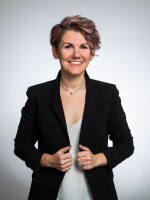
In this episode, hosts Brianna Lennon and Eric Fey speak with Ben Adida. He’s the co-founder and executive director of VotingWorks, a nonprofit organization that builds open-source voting equipment.
They spoke about what an open-source system actually is, some of the challenges of getting new voting machines through the certification process, and about the overall health of the voting equipment ecosystem.
This episode is part of a three-part series focused on election technology.
High Turnout, Wide Margins Credits:
Managing Editor: Rebecca Smith
Managing Producer: Aaron Hay
Associate Producer: Katie Quinn
Digital Producer: Mark Johnson
Transcription of the episode is as follows:
Ben Adida: I do think it would be good if we all came together and thought about how do we make this market more dynamic, right? You asked about, like , what happens if somebody takes my software? I would love for somebody to take my software and build a better voting machine. Great, like do it. Let's compete. Let's make each other better, right? But I think it's pretty unlikely because the activation energy is pretty high.
[High Turnout Wide Margins Introduction]
Eric Fey: All right, everybody. Welcome to another exciting episode of High Turnout Wide Margins. My name is Eric Fey, Director of Elections in St. Louis County, Missouri. I'm here with my co-host —
Brianna Lennon: Brianna Lennon, County Clerk in Boone County, Missouri.
Eric Fey: And on this episode, our guest is —
Ben Adida: Ben Adida of VotingWorks.
Eric Fey: And Ben Adida, why do you love boring elections?
Laughter
Ben Adida: That's a great question. “I love boring elections” is a funny tagline for our socks, for our stickers, etc. but it actually encompasses a lot of what we care about and what we can talk about today, which is, elections that go well on the technical front, where the equipment doesn't fail, they can be boring, and that's good, right? You don't want the — you want boring.
Eric Fey: And we want to definitely get into all that —
Ben Adida: Yeah.
Eric Fey: — because we love to be the podcast for people that love boring things.
Laughter
Eric Fey: But before we get to that, Ben, we ask all of our guests, first off, their election origin story. How did you get into the election space? What brought you here?
Ben Adida: Yeah, so unrelated to this podcast, somebody asked me this question about a month ago, and I had some time to think about it. So, it actually goes back to seventh grade, and seventh grade for me is the late 1980’s. I was at a fairly tech forward middle school, and we were voting for student council, and to vote for student council, we lined up outside the door of the computer lab, which was full of Apple IIes and Apple IIcs, and we walked in and we voted on the computer. And I remember thinking, “How do I know that the computer has properly recorded my vote? Oh, I'm just a seventh grader. They've probably figured it all out.” And I went on my merry way, and whoever got elected got elected. It was only later that I realized actually this is a really big controversy around elections that's not just for seventh graders. So, that's the first time I got into elections. Then, the next time was as an undergraduate at MIT, where I got to do some work with Professor Ron Rivest, and got really interested in the security aspect of elections. When you study cryptography, folks will tell you that it's not just about the math; it's about trying to resolve problems that are seemingly contradictory and then solving those contradictory problems with math. For example, how do I encrypt a message where anyone can encrypt it, but only you can decrypt it? That's somewhat contradictory. Cryptography can solve that. The equivalent in elections is almost like the grandest of cryptographic problems, which is how do I allow everyone to be confident that their vote was properly recorded, while also keeping their ballot secret? That kind of tension in requirements is where I really got my initial interest in elections, like, that's cool. That's a really interesting technical problem.
Brianna Lennon: So, I guess jumping into VotingWorks.
Ben Adida: Yeah.
Brianna Lennon: It's the only open source tabulation software right now that exists, has been developed into a full tabulator and ballot marking device and all of the things that you would come to expect with a voting system —
Ben Adida: That’s right.
Brianna Lennon: — and, I think, incorporates in some of that cryptography question of auditing it after the fact and things like that. So, can you talk a little bit about what went into the development of VotingWorks and what — I mean, you've said what you're trying to accomplish, but why is it specifically that this is accomplishing your goal?
Ben Adida: Yeah, it's a great question. So, we started VotingWorks almost eight years ago, and the idea was to build better voting equipment that would make it easier for Americans to trust their elections. And a little more than eight years ago was pre-2020, so it wasn't, you know, trusting voting machines wasn't top of mind for everyone. Initially, the idea of open source was just, “that's how you build secure software.” It wasn't going to be a major part of our marketing, right? It's like, yeah, if you build modern secure security software, you do it open source because — well, I can go into that — because the transparency means that, the open source folks like to say, “With a million eyeballs all bugs are shallow.” Like, just a lot of people looking at it, the bugs just get solved over time. But before 2020, it was more, “That's what we do.” It's just standard, right? And then after 2020, when people started asking a lot of questions about, “Well, how do I know what this voting machine is doing? How can I trust it?” We were actually in rural Mississippi talking to election commissioners there, and we started getting questions in 2021 about the source code of our voting machines — not the usual conversation you would expect when you're talking to folks who are running elections. We understood that actually, you know what? Understanding the source code of voting machines, understanding the accessibility, the transparency is going to be a much bigger deal. That's when what we were doing, just as a matter of course, became a bigger part of how you trust a voting machine.
Eric Fey: So, for somebody who, in seventh grade, rather than thinking about the security of this voting system, I was more concerned about making my pencil sharp enough to stick in the ceiling.
Laughter
Eric Fey: What does it mean for the source code to be open?
Ben Adida: Yeah.
Eric Fey: Versus what whatever everybody else is doing.
Ben Adida: Yeah, absolutely. So, all software is written — mostly by humans, but these days increasingly by AI. Although, we write all of our software with humans. You can think of it as the recipe for some cake, right? That's the source code of the software. The instructions that tell the computer what to do, right? When you click this button, then when you click that button, like what do you do? They're just the instructions, right? And open source means that those instructions are available on the web for anybody to see and observe. “This is what it's doing.” To pick a specific example, when a bubble is filled and is scanned by a scanner, and there's an image of that bubble, and it's being interpreted by software to determine is that bubble filled or not? What exactly is happening, right? “Oh, I'm looking at these pixels. I'm comparing, I'm aligning the grid. I'm finding the bubble. I am counting the pixels that are filled. I'm finding that they're above a certain threshold.” All that is instructions, right? In code. And ours is up on the web. You can go see right now how the VotingWorks tabulator interprets those bubbles, and we think it means you can trust it more because you know how it's working.
For other vendors who have closed source code, you can't see that. The testing lab gets to see that — when you go to EAC certification — the testing lab does have access to source code, but nobody else can, right? You know, we should be clear that there's usually enough code there that the testing lab isn't going through every single line, right? So, being open to us is pretty important for rebuilding trust. But that's what it means — it means those instructions are up there. You can see them. It actually means a little bit more in that you can take any line in our source code, and you can trace it to when it was written, which engineer wrote it, which engineer reviewed it — because every line of source code in our system is written by one person and reviewed by another person — you can trace it to the discussion that happened around the review. “Why did you write it this way? What about this way?” Like that conversation is archived and can be viewed, so you have a complete audit log of everything, all the decisions that went into deciding what that line of code should be. We think that's, I mean, I think that's pretty cool, and it gives you a level of transparency that I think we need, right?
Brianna Lennon: So, one of the arguments — because the opposite of open source is proprietary.
Ben Adida: Yep.
Brianna Lennon: — and there are sometimes arguments that, “Well, if it's proprietary, that means also that bad actors can't know how it's working exactly to be able to manipulate it or to take advantage of it. Open source, it's all there. What's to stop somebody from creating a virus that specifically targets a piece of open source code and then somehow injecting that in?” What has VotingWorks done to address that?
Ben Adida: To address that, yeah. So, is it okay if I tell you a little story?
Brianna Lennon: Absolutely.
Ben Adida: The story I'm about to tell —
Eric Fey: Only if it's boring.
Laughter
Ben Adida: Well, I'd love to tell you a story. It's a story that I'm going to tell tonight at the conference. I have five minutes to tell it. I won't take five minutes here. I'll try to make it short. So, this story takes place in 1851. There's a guy named Alfred C. Hobbs. He's an American, and he is on a boat to England to attend the Great Exhibition of London, and he's a lock salesman. That's his job, and he's really good at his job. What he does is he goes to banks that he wants to sell his lock to, and he picks their lock, and then when they go, “What?” Then he's like, "Well, I have a better lock for you,” and he cleans up. He's really, really good at his job.
And he's on his way to this conference because on display at the Great Exhibition of London is a lock called the Chubb Lock — C H U B B — you may have seen locks that still have that brand. That brand still exists, and it's supposed to be an unpickable lock. And he goes to the conference, and he picks it in 30 minutes, and when people don't believe him, he picks it again in seven minutes, and then he goes down the street to Piccadilly Circus, where there's another lock called the Bramah Lock that's been sitting in a storefront window for 61 years, unpicked, with a reward for anybody who can pick that lock. And he picks that lock too.
And, at the time, the press dubs this “The Great Lock Controversy of 1851,” like, you can look it up. It's got a page on Wikipedia. “The Great Lock Controversy of 1851.” It's not just because he picked the locks that it's the “Great Lock Controversy,” it's because he tells everybody how he did it. He tells everybody what the weaknesses in the mechanism of the lock, and how he picked it, and everybody in the press is going, “That's just irresponsible. Why would you tell other people how this lock is architected, is designed? Aren't you making it easier for the thieves to get in?”
Two years later, he publishes a book on the design of secure locks, and he gets participation from Mr. Chubb and Mr. Bramah, the two designers of the locks, and they publish their updated designs of their locks since he broke them. And in the book, he says, “This idea that you are going to protect yourself by keeping the design secret is wrong.” Basically, he's saying the bad guys always know how to get in. They're always going to spend the time, they're always going to figure it out. All you're doing by keeping your design secret is you're preventing all the good guys from helping you make it better. And all the three top lock makers in the 1850s come together in this one book to say, “You should open up the design of your locks, and that will make them more secure.” So, we've known since the 1850s that's actually how you design security systems, right? And if you go outside of voting systems and you look at how, you know, cloud software is developed, how the Android operating system is developed, how every major web browser is developed, the Signal encrypted messenger — they are all open source, right?
There's even, even the F-16 fighter jet is built on an open-source platform. The F-16, right? Like this is, you think, “Well, hold on. How is that good?” It's because that openness, it does a couple of things. One, it opens it up to all the good guys to help actually fix any problems that come up, right? Two, it raises the bar on how you design it because if you know that you're designing something in the open, you're not cutting corners, right? We're all humans. We'll cut corners every now and again if we can get away with it, right? At VotingWorks, we can't get away with it. If we cut a corner, someone's going to point it out on the internet, right? And so, we have to design it in such a way that it is secure even when it's public. We have to do it that way. And that makes it more secure, right? The way I talk, the analogy I give is: you're on the highway, and there's a state trooper next to you — everybody's driving the speed limit, right? Somebody's watching, you're driving the speed limit. If nobody's watching, you might speed.
[High Turnout Wide Margins Midbreak]
Brianna Lennon: So, where is VotingWorks being used right now? I think, in the life cycle of vendors, many vendors started as companies that did other things. They were printing companies. They did something else, but they existed before they started becoming voting equipment vendors. So, they have somewhat of a head start on you.
Ben Adida: Yeah.
Brianna Lennon: But it also means they've been through the certification processes and all those things, and eight years is a relatively short amount of time. So, at the moment where are you certified, where are you operating?
Ben Adida: Yeah, so we are certified in the state of Mississippi and certified in the state of New Hampshire. We have voting machines deployed in the state of Mississippi and in the state of New Hampshire. [It] is our newer place where we're deployed. We have 38% of New Hampshire using our voting system, so it's kind of fun. I live in Massachusetts, so not too far from New Hampshire. I meet plenty of people from New Hampshire, and flip a coin, generally, they're using our voting equipment in New Hampshire. Maybe a slightly biased coin, right? Since it's 38%. So, that's a ton of fun.
Our system has been submitted and tested to the latest standard, VVSG 2.0 [Voluntary Voting System Guidelines]. The test report has been filed, and the EAC is doing its final review. So, we should very soon — maybe even by the time this podcast comes out, we'll see — be VVSG 2.0 certified. At that point, we'll be only the third vendor to reach certification to that standard, and we will certainly be the first open source vendor to ever get federally certified. And we're talking to a few other counties and states about adopting our equipment.
We did do something similar to what other vendors have done, which is we also have software and services around post-election audits, right? So, the Arlo software that is used in more than 10 states now, and we provide support and hosting for that software. And then, some people use it on their own because it is open-source software. So yeah, that's another, that's something we were able to do faster than the voting system because, as you pointed out, the voting system takes many years to develop and iterate and certify.
Brianna Lennon: So, now we've talked about the importance of open source and we've talked about the certification process, it seems like there may be a contradiction — in the open source software, it will become that much more obvious if there is a vulnerability or a patch that needs to be done, but the certification process is extremely slow. So, is that a calculus that you have that, “All right, well, as it goes through, as more people adopt it, as there's more eyes on it.” How do you strike a balance between being able to stay secure when things are publicly out there, and still being able to remain certified when the certification entity may be very, very slow.
Ben Adida: Yeah, it's a great question. So, again, the one thing I would emphasize is that vulnerabilities happen in closed source systems also right? And they have just the same certification problem right? We've seen a number of vulnerabilities recently with one of the other vendors, right? Talked about at DEFCON and whatnot. So, I think you're putting your finger on an important problem, which is vendors have to be able to fix these things quickly. There's two parts to that that are difficult. One is you have to get it certified, and the second thing is you have to get it deployed. Because unlike software on our phones that just auto updates, all of these machines are not connected to the internet — you have to go out and do the process of updating, right? So, how we're addressing both is we're just really — one, we're just really good at patching this stuff really quickly, right? We use modern open source platforms — Linux, etc. — where if there's a vulnerability in a package, we can update it and go. Actually, there's three things. That was the first one. The second thing is these things are never connected to the internet, so a lot of the vulnerabilities you find in software can be exploited over the network, but to exploit them in person is a lot more difficult, right? And especially when you're inside a sealed box where you don't have access to USB ports and things like that. So, even if there's a vulnerability, exploiting it might take quite a bit of effort, and so, it gives us time to go ahead and get it certified and fix it. And the third thing we do that we spend actually a lot of time on is making software updates on the machines particularly easy, but only with digitally signed code. So, the code has to go through certification. It has to get certified. It has to be digitally signed by us. And then once that happens, installing it on a given tabulator, for example, is five minutes. You plug in the USB drive. You power on the machine, the USB drive that has the signed new code. You power on the machine, it finds the code, it installs it, and reboots. And five minutes later, you're up and running. So, that's a part that's sometimes not as emphasized, right? “Oh, you have to go through certification,” which is true. But even if you do, sometimes it's then hard for states to deploy the update because they have to go to 10,000 machines, BMDs [ballot marking device], tabulators, and whatnot. So, we've worked to make that part as fast as possible and really pretty easy.
Eric Fey: I'd love to get your thoughts, Ben, on just, kind of, the health of the voting equipment ecosystem, the market, the industry. I know — I want to say it was like the Wharton School put out some kind of report like a number of years ago?
Ben Adida: Yes.
Eric Fey: And I read it, and it was fascinating. So, there are these kind of technological challenges we've started talking about here, but there's also this business challenge of, like, IBM was in this space decades ago, and because an election went bad, it was bad for their brand, so they got out of it.
Ben Adida: That's right. Diebold.
Eric Fey: Diebold, which was a company that made highly regarded ATM machines and other things — it ruined their brand. And so, Apple and Microsoft and these other companies don't really exist in this space as a frontline vendor, for that reason, I think, by and large. So, having now kind of gone through this process —
Ben Adida: Yeah.
Eric Fey: — what's your opinion of the state of the market?
Ben Adida: I think it needs to be a lot better. I think, and I think there's a lot of — there's not a lot — there's a few key things that are preventing this market from being as good as it can be. The Wharton report was one of the reports that inspired VotingWorks' existence, right? Because one of the recommendations it makes is open source. The report basically says, it's on the business of voting machines, if I remember correctly. It says, “You have a highly regulated, highly fragmented market,” right? “Not every state needs the same thing, and not a lot of money in this space.” So, there's only two ways that you're going to solve this problem — that's the report. One is open source that makes it easier to customize for different states, and the second one would be if the states got together and agreed on one set of requirements, and I'm like, “Well, good luck with that second part. That's going to be tricky.”
Laughter
So, really, open source is the way to go, right? It is one of the things that inspired us. I think all those things remain true, right? There's the highly regulated, the certification process, right? I think there's a number of things that the EAC could do to reduce the burden of certification. It's not a personal, like, it's not an individual human problem. There's nobody at the EAC that's making this harder. It's just the system of certification is such that usually requirements get added, never taken away, right? And so, over time, it just becomes harder and more costly to do this. And you get to a point where the design space for voting systems, like what you can design, is pretty narrow, and the sort of “is it worth investing in this” question is often no, right? Like, you're not going to sell that many voting machines and whatnot. So, if we want a more dynamic market, we have to make it less expensive to develop voting machines, and that means reviewing the standards and saying, “You know, maybe this one was actually too much and we don't need it.” That's a hard process, but I think it's necessary.
I don't know if we can hope one day for there to be more money in this market, right? Like, would we accept more expensive voting machines if they have better features, and would we be able to fund those more expensive voting machines?
But what you see in this market is the result of the incentives that exist. The incentives that exist are to build for certification because that's the hardest thing, and then to not change the product very much because updating it is hard. And so, the machine might work really well in one state, and then it's kind of a round hole square peg in a different state, but adapting it is really hard, so it's not a great market. One of the reasons why we are structured as a not-for-profit at VotingWorks is because it lets us focus on the mission and not on maximizing profit. As a result, we're able to be more product-focused than maybe other vendors are because we're out to break even, we're not out to make a ton of money, but I don't know — can this industry be just a bunch of not-for-profits? And that's not clear, right? It's probably a good idea to have different models going at it. We're eight years old. We're the youngest vendor. I think the next one is like 18 years old, and the next one after that is 40 years old, right?
Eric Fey: That’s crazy in any other industry, right?
Ben Adida: Right. So, it's a great question, and I do think it would be good if we all came together and thought about how do we make this market more dynamic, right? You asked about, like, what happens if somebody takes my software. I would love for somebody to take my software and build a better voting machine. Great, like, do it. Let's compete. Let's make each other better, right? But I think it's pretty unlikely because the activation energy is pretty high.
Brianna Lennon: I would love to hear your thoughts on — as the landscape has veered more beyond just the voting equipment. You have risk limiting audited software — there's a lot of push towards vertical integration. I think, my opinion, because a lot of the outlying stuff is not subject to certification, so it is easier to spin up a new voter registration database or a new election night result. But my concern is always that if you put all your eggs in one basket with one vendor for all of those different things, and one piece of it fails and it brings down the entirety of the system —
Ben Adida: Yeah.
Brianna Lennon: — and you have to explain, as an election official, why your election night results are not working, but your tabulators were okay, but you can't tell people why.
Ben Adida: Sure.
Brianna Lennon: That you're kind of setting yourself for failure. How do, do you feel like vertical integration is something that is on the horizon of this field right now?
Ben Adida: So, it's a great question, and I'm going to try to do it justice, but I don't know if I will be able to. Historically, as you pointed out, the poll books, the election night reporting, the voter registration database — those have been outside of the certification regime, and that's allowed actually a little bit more innovation, right? As we talked about in those fields, and it's required some kind of standard interfaces between the poll book and the rest of the system. There's a barcode that you move over, you know, that the companies have to work out — some kind of way to connect those things. I think that works okay. You're right that if something goes wrong, the press will probably report it incorrectly. It'll just be, “Something went wrong,” and we won't know if it was the voting system or the ballot on demand system or the what[not], you know?
It would be really nice if you could get the best poll book system, combined with the best ballot on demand system, combined with the best tabulator, combined with the best BMD, and they don't necessarily have to be from the same vendor, right? I think that would be nice, but there is a risk that, at that touch point, the vendors will then blame each other, right? “Something went wrong between the BMD and the tabulator.” All right, well, each vendor will point to the other vendor. So I — it's not a very — I don't have a good satisfying answer to your question. I think, like every other field, you have advantages of verticalization, right? You live in the Apple ecosystem: everything works beautifully together, except with that one family member —that would be me — using an Android device, and then you're like, "Why can't Apple, you know, give me parental controls for my kid's iPhone on my Android phone?” Because they just don't do that, right? But if everybody's on Apple, it's wonderful, right? And I think those same issues apply in the voting space. My sense is that we could absolutely — and we have to some degree — we could do a better job as an industry of defining those boundaries between the poll book system and the ballot casting and tabulation system, like, make that a standard interface, that would be wonderful, right? We have defined standards in VVSG 2.0 for election night reporting, where that data can come out of the voting system and then go into any election night reporting system. I think those are good. I think we should strengthen those standards, and I don't think we need those things to be fully integrated. If somebody wants to sell a fully integrated voting system, they should do it on its merits. Like, it's that much better than getting a poll book from a different company. Great, let's do that. In the future, maybe we'll figure out the interfaces between tabulators and ballot marking devices, but that is next level hard, right? Like, how to make ballots that are effectively interoperable across vendors. We're nowhere near that, and I don't think we're going to be there anytime soon.
Eric Fey: You've been listening to High Turnout Wide Margins, a podcast that explores local elections administration. I'm your host, Eric Fey alongside Brianna Lennon. A big thanks to KBIA and the Election Center for making this podcast possible. Our Managing Editor is Rebecca Smith. Managing Producer is Aaron Hay. Our Associate Producer is Katie Quinn, and our Digital Producer is Mark Johnson. This has been High Turnout Wide Margins. Thanks for listening.