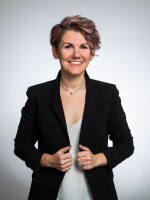
In this episode, hosts Brianna Lennon and Eric Fey speak with Casandra Hockenberry. Previously, she worked at the Council of State Governments’ Center for Innovation, but is now serving as the Program and Policy Director for Advance Elections, a nonpartisan, elections-focused consulting firm.
They spoke about how election administrators can more effectively help overseas and military voters cast their absentee ballots, as well as the importance of consequence planning alongside emergency managers.
High Turnout, Wide Margins Credits:
Managing Editor: Rebecca Smith
Managing Producer: Aaron Hay
Associate Producer: Katie Quinn
Digital Producer: Mark Johnson
Transcription of the episode is as follows:
Casandra Hockenberry: I have watched so many states and jurisdictions say, "Hey, we have drop boxes. Use those instead of inundating the U.S. Postal Service and things like that,” but if someone's just not paying attention and taking their time to request their ballot, or you know not showing up until the 11th hour — you can only do what you can do.
[High Turnout Wide Margins Introduction]
Brianna Lennon: Welcome back to another exciting episode of High Turnout Wide Margins. My name is Brianna Lennon. I'm the County Clerk in Boone County, Missouri, and with me is my co-host —
Eric Fey: Eric Fey, Director of Elections in St. Louis County, Missouri.
Brianna Lennon: And today we are live from the Election Center Conference in Kansas City, and we have with us —
Casandra Hockenberry: Hi everyone. I'm Casandra Hockenberry. I'm the Program and Policy Director for Advance Elections.
Brianna Lennon: Why don't you tell us more about how you ended up working in elections?
Casandra Hockenberry: It's a great question. Thank you both for having me. I really appreciate it, and I've worked with Brianna for years, and this is the first time meeting Eric. So, great to be here. How did I get into elections? So, before I was in elections, I was a public defender in Appalachian Kentucky, and it was a lot. And I sort of got to the point where I started to get a little jaded, a little exhausted with 3:00 a.m. phone calls to crime scenes.
So, I wanted to do something where I could still make a difference, but was maybe a little less emotionally taxing. And I thought elections were that — turns out I was wrong, wildly wrong. I started at the Council of State Governments, working on their Overseas Voting Initiative, which is all about supporting military service members, their families, and citizens living overseas when they're trying to vote, helping break down some of those barriers that they have.
And that was amazing, and I absolutely loved it. Fell in love with the community and the people, and can't imagine doing anything else.
Brianna Lennon: What was — well, I mean, you mentioned that you were hoping that'd be less taxing?
Casandra Hockenberry: Yeah, so I started in 2019, and it was like —
Brianna Lennon: You had like a good six months!
Casandra Hockenberry: I had one whole, like, not crazy year, and then obviously 2020 happened, and I was like, “Oh, oh no.” So, since then, I haven't gotten to experience any other normal elections, but it's been amazing.
Brianna Lennon: So, I've gotten to work with you in some of the initiatives, although I think that there, I feel like there are more initiatives than meets the eye when it comes to overseas and military voting. Do you want to talk a little bit about what your role in Council of State Governments focused on?
Casandra Hockenberry: Yeah. So, we had a project with the Federal Voting Assistance Program, and it was really about giving FVAP the opportunity to connect and collaborate with state and local election officials. So, we built this working group of 30, give or take, state and local election officials to come in, talk about the issues that they're seeing. We really tried to — as we were, as we craft the working group each iteration — to get a really diverse electorate.
So, large jurisdictions, small jurisdictions, large UOCAVA [The Uniformed and Overseas Citizens Absentee Voting Act] populations, small UOCAVA populations. All of those things. So, we worked really hard to make sure that we had a pretty broad representation, so that any best practices, anything we put out — could be scalable. So, you know, LA County can use it, and Shootsbury, Massachusetts, can use it. So, it's always important to us that anything that we're coming up with is going to be able to be translate[d].
We've done a lot of really cool stuff at the OVI, and I'm so thankful for getting to work there. I think the project I personally love the most is our Section B data standard for EAVS [The Election Administration and Voting Survey], which is really focused on collecting the transactional information, so that we can have a better understanding of what's going on. My biggest, the one that I like to tell is on the EAVS, it just says how many ballots arrived “not timely” and were rejected for that reason. But you don't really know what's going on?
Whereas with the transactional level data, we're able to dig in and say, "Oh, you know, this person requested the ballot well in advance of the election. It still didn't make it back. They actually requested a second one.” So, you know, we see sort of that pathway, and we can understand that, like, “Okay, maybe there's a structural issue or or a policy issue that could affect and change this.”
We can also see when someone requested their ballot five days before the election. They live in France and they had to return it by mail, and of course, that's not making it back, you idiot. So, you know, what can we use policy to change, and then what does policy not is not going to be able to affect at all, and so, you can't policy your way out of a disengaged voter, and so, let's not hold election officials accountable, so to speak, for those sorts of things.
Eric Fey: I just love your line there. “You can't policy your way out of a disengaged voter.” I feel like that's not put forward enough.
Casandra Hockenberry: I completely agree.
Brianna Lennon: So, obviously, one of the biggest challenges that I think you worked through were working with the post office and bridging the gap between the post office and election officials and things like that. What are you — what lessons have you learned from that? That maybe, even if it's not super useful for election officials because it's just the way that it is, but what surprised you the most? What have you taken away from it?
Casandra Hockenberry: So, I mean, I think we all know the United States Postal Service is so under-resourced, and they are doing, I think, you know, the best that they can with what they've got. I think something we in the election community need to do is, I think a lot of election officials have great relationships with their local post office and things like that, but sometimes in the middle between that local and the election team in D.C., there's a lot of gray that we don't know what's going on.
My recommendation is, you know, elevate it to that election team. They're going to do everything they can. Adrian and Matt are phenomenal. I had the opportunity to work with, have worked with them for a long time, and there have been calls where I'm like, “How many people are on this call from the United States Postal Service?” But it's because so many of their positions are very niche that they genuinely do need all of those individuals, but Matt and Adrian are always so helpful.
The other thing I say is, you know, reach out to me, and then I can, you know, call them because I do have their numbers. They do, they recognize my email in their inbox, and so, they're going to, I might be able to get them on the phone and say, “Hey,” like, “we need to run this down.” The other thing we —
Eric Fey: Can I ask a question real quick about that?
Casandra Hockenberry: Please do.
Eric Fey: Just to follow up. So, I've had a similar experience just as a local election official, but sometimes I think how realistic and sustainable is this that for what really should be kind of lower level mundane issues, we've got to call or send something to Washington to get this dealt with, and then they send it back down the chain, and they are responsive in that way, but like, there's got to be a better mousetrap.
Casandra Hockenberry: There’s got to be a better way. I don't know. You know, I think part of the problem is the United States Postal Service is so massive, and so, you know, bless their souls, they're always like, you know, “We're doing trainings, we're doing these things,” but just like you can't policy your way out of a disengaged voter, you can't train your way out of a disengaged employee, and so, I think that's a lot of the times the problem, like they're doing everything they can, but if people don't want to listen in the training…
I agree that it's not sustainable in any way, shape, or form. Mostly because, God, I can't imagine how burnt out they are, because they're getting calls nonstop. I don't know how to fix it. We need to fix it, and there needs to be something. I know they're certainly, with some of the changes, they're definitely looking into what are the technological things that they can employ to help speed things up, make things process better, but I don't know. It's not sustainable, Eric. You're absolutely right. Yeah.
Eric Fey: Yeah. Well, we could go on about USPS for sure.
Casandra Hockenberry: Absolutely. Absolutely.
So, what I will say is the other thing that I've learned is, you know, we — because traditional absentee voting, we do work so much with the post office — everyone's pretty aware of that, but I get the opportunity to work with the Military Postal Service Agency and the Department of State as a part of all of that, and it's been very enlightening as to how limited their operational capacities are.
The Department of State is in charge of diplomatic pouches, as well as the diplomatic post office. Military Postal Service Agency, they're the ones delivering all of the mail to the service members, you know, and they're scanning every single package that's going out, and unfortunately, the election does, in fact, coincide with Christmas and those Christmas mailings, and so, they have a really hard time. You know, at the end of the day, unfortunately, most service members would say, "I much rather get my care package than my ballot,” so, those get prioritized, and certainly, rightfully so, but it can cause some issues there too.
Brianna Lennon: So, for, because I think probably the majority of election officials do only have a handful —
Casandra Hockenberry: Absolutely
Brianna Lennon: — except for the places that have bases and things. What are you hearing from voters that we should be doing differently to help those voters?
Casandra Hockenberry: So, I don't think — some of the problem is voters are not necessarily aware of what they actually have access to. We do a survey. The states administer a survey to UOCAVA voters, and it's sort of a customer satisfaction. We want to understand their experience, so not a scientific survey. I'm not trying to extrapolate anything, and unfortunately, very frequently we have voters say, "Well, I wish I could have,” you know, “returned my ballot electronically. The mail is terrible,” and, very frequently, they live in states that do have electronic ballot return. To which I'm like, “Well, I don't know what to do for you, sir.” But it tells states, “Okay, we need to maybe bring attention to this access, that sort of thing.”
I think overwhelmingly, the feedback we get back from voters is like, “It's just so complicated. I can't figure it out.” The other thing we hear a lot, particularly in states where those voters are able to vote in their down ballot races, they say, “I had a really hard time finding out about either my state candidates” and certainly their local candidates, and so, that's been really eye opening. I know the Overseas Voting Initiative will be putting out a resource around voting guides — so, things that typically, you know, these are in some of the western states have them, or states have them about ballot initiatives or constitutional amendments. But being able to put that candidate information, even all the way down to those random local, you know, water conservation managers can be really, really helpful for those voters because they kind of feel disengaged. They're not seeing, they're not getting the campaign mail, they're not getting the campaign ads — which they're probably happy about that — but that means they don't necessarily know who's running, what that platform is, that sort of thing.
[High Turnout Wide Margins Midbreak]
Eric Fey: I don't know how long we've gone, but if we — I don't want to run out of time without giving you a chance to talk about Advance Elections.
Casandra Hockenberry: Yeah.
Eric Fey: And what that's all about.
Casandra Hockenberry: Absolutely. So, Advance Elections was founded by Karen Brinson-Bell, former state election director from North Carolina, who saw North Carolina through COVID and Hurricane Helene, and then Chris Piper, who's the former commissioner of elections for the state of Virginia.
So, we've got two state election directors who are absolutely phenomenal, and they reached out, they've got more on their plates than they, you know, have hands to to work on. And so, they — I've worked with Karen for a number of years on the Overseas Voting Initiative, and participated in a program that they are running — the Partnership for Elections and Emergency Response, and they saw that I was very excited about the the project because there's nothing I love more than writing some best practices and recommendations. So, they asked me to to join the team, and I'm so happy to be working with them and and standing up the the partnership
Brianna Lennon: For the policies that you're going to be working on, what are you looking forward to the most?
Casandra Hockenberry: Yeah.
Brianna Lennon: And how different is it being now in, I guess, would be the private sector?
Casandra Hockenberry: Yeah, very weird. It's very weird to have shifted. I keep joking, you know, I love the Council of State Governments. They are a phenomenal organization to work with, phenomenal mission, but they are a nonpartisan membership organization, and so, I had to go through like 10 layers of approvals for anything, and so, it's Karen and Chris, and they keep being like, "Stop bothering me! Yeah, do whatever.” So that's been a very weird transition for me, but really, really fun and exciting.
The projects that I'm really excited about — so, we are putting out a playbook around how elections officials and emergency managers can kind of work together, really providing the framework for that relationship. What are the things you need to be thinking about? That sort of stuff. And so, a lot of the things that we're working on are hoping to make it easier and more effective for these two groups to work together. You know, one of the worst things that can happen is reaching out to your emergency manager when there's an emergency, not, you know, before.
So, some of the things that we are really talking about is trying to make sure everyone's kind of on the same page, understands what's going on, and more and more frequently, you know, how do you know where you, as an election official, stand in the priority order? And obviously, on Election Day, you're probably going to be significantly higher than than — you're never going to be higher than the hospitals, and, no offense to election officials, you shouldn't be. But you're going to be pretty high up there on Election Day, and and during an early voting period, and that sort of thing.
And so, making sure that those emergency managers know what you're going to need, like what's a “I have to have this,” “having this is going to be really really helpful,” and like, “we don't need this, but if you have a spare, you know, ream of paper, it'd be great.” So, really working through that and trying to make some of these things as automatable as possible.
Election officials are already learning how to de-escalate, and we're asking, in my opinion, way too much of you all. You're experts in social media now, in cybersecurity, and de-escalation, and physical security, and, you know, and so, I’m like — what can we do so that you don't also have to be the emergency manager, leaning on your emergency manager in your county, in your city, state, etc., so that you don't have to think about it as often.
Eric Fey: Last year — yeah, it was last year — I was part of a meeting with election officials and emergency managers, and that was really interesting. So, is that something you all are going to keep going for?
Casandra Hockenberry: Yes, absolutely. So, we are going to continue having those convenings. We work with the International Emergency Management Association, the National Emergency Management Association, and big city emergency managers — a number of those membership organizations because there is an organization for every single position in government.
And it has been really fun to meet the emergency managers and talk with them because I think, in terms of — our missions, are obviously different. Election officials are running an election. They're managing it, but both organizations are very mission-driven. They become political footballs, you know, but, at the end of the day, they are very much non-political, they're trying to just make sure everyone's safe and secure through these emergencies. And so,that's been really great to see that, you know, again, regardless of political affiliation, they're like, “Yeah. I'm just trying to make sure,” you know, “the water gets turned back on, the electricity turns back on.”
And then, the other thing that's been really fun is learning how much they have their hands in. Emergency managers know everyone, like they are the best facilitator of relationships because they have their hands in so much, you know, if there's a security incident, they're going to be a part of that. If there's just a bad car accident or a storm or, you know, any of that stuff, they're really involved. They're also going to be able to — they keep up with sort of public utilities work, and so, maybe your polling location is in an area that's about to have some utilities work done, and your water is going to be turned off. They're going to be able to reach out and maybe get that delayed for you and stuff. So, they're really great to have on those calls as a coordinator and to build that. So, we're really excited to bring them into that more and they are, as well, because they find it fascinating.
Eric Fey: What do you want election officials to know about emergency management? Something you've learned about it since being in this position that you think election officials should know more about?
Casandra Hockenberry: Yeah. Okay. So, I'm actually really excited about this — this is consequence planning. So, I think we, as election — I, as like an election policy person, I would never, you know, pretend to even know what it's like to actually administer an election — but, as a policy person, one of the things that I thought about when I thought emergency management is I went through all of the hazards, everything that could happen, and I started talking to Alex Jadrich, who is the — he's an emergency management professional in the city of Denver.
He's like, "Yeah, but those don't matter. What matters is the consequences of it, and you need to think about those specific hazards when you're thinking about your crisis communication.” So, you know you're going to handle, “Oh, it's a hurricane” versus an active shooter very differently in your crisis communications, but in terms of the consequence, at the end of the day, it doesn't matter if, you know, a car crash rendered the polling location unavailable, a power outage happened, a storm happened — if you have to set up a temporary polling location, that's the consequence, and that's what you need to be thinking about first in terms of resources.
And so, what we are going to be doing, as we put out some resources, is really educating around consequence planning as your first step, and then building out sort of the lines with hazards. I think it makes it a lot less overwhelming because when you're thinking about all of the hazards, you're like, “Well, I need to have a plan if this happens and this happens.” No, you need to have a plan for how to, you know, set up a temporary polling location. You need to have a plan for, you know, alternative communications. You need to have a plan for a sudden change in the law that means that you have to run your election differently, but you don't necessarily have to plan for every single potential hazard from the consequence side of things.
Again, crisis communications — yeah, you're going to handle all of those differently. Think about that later. But having your consequences planned out is really, really helpful, and I think something that was very eye-opening in talking to the emergency managers because they're like, "Yeah, I don't care what caused it. I just need to know if I need to set up a new polling place or like your power went out, so I need to get you a generator,” that sort of thing.
Brianna Lennon: I really like that. I wonder — the biggest mental obstacle I have when I'm thinking about planning for something going wrong is that it's hard sometimes to determine if this goes wrong. It's probably an indication that five other things went wrong, and so making a plan for that thing misses the broader picture.
Casandra Hockenberry: Broader picture. Absolutely.
Brianna Lennon: And it sounds like consequence planning will catch that a little bit better.
Casandra Hockenberry: That's my hope. My hope is that by focusing on that consequence, you're identifying the end result, and then a lot of those other factors can be brought in through other things. Those are going to be — your disaster recovery plan is going to probably take into account sort of all of those factors that you're not thinking of, but yeah, looking at that consequence as like the big ball of what you need to get done is, it has been, at least for me, very — I don't want to say calming. It's not calming at all — but way less overwhelming. There's just so many less factors you have to think about when you start there, and then I think it also makes all of the other planning a lot more manageable because then you're going, “Okay. So, once we have this solved, here’s how we talk about it,” or “here's how we move through that,” or “here's how we recover on the back end.”
So, that's the thing I'm really excited about, and really getting election officials to think about it. I'll be completely frank. I've read some COOP plan templates, and I'm like, “This is 80 pages. This is way too much.” Like I can't imagine sitting down as an election official and being like, "Okay, now I need to think of all of the…” — no, let's make it as easy and turnkey.
Eric Fey: I'm really glad you brought up COOPs [Continuity of Operations Plan] because that's the thing right now., like, people are pushing us all to have coops. We have COOPs.
Casandra Hockenberry: Absolutely.
Eric Fey: But you know it's a huge document.
Casandra Hockenberry: Massive.
Brianna Lennon: And it's mostly copy and paste. I mean —
Eric Fey: Yes.
Brianna Lennon: — almost every time that somebody talks about a new template, they're like, "Yeah, just fill it in, fill it in with the most basic stuff that you have,” so that you can call it good and you're done.
Eric Fey: Yeah.
Brianna Lennon: And then it's never reusable.
Casandra Hockenberry: No, absolutely. And if it's that many pages and you're in an emergency, — you're not hauling around the four four inch binders. Those aren't, it's not helpful, you know, and something, you know, I think in the security committee the other day, someone mentioned, you know, “We just go through. We go, ‘Yeah. We sign off on it.’” And he said, “Five years later, we did an actual look at it and went, ‘Oh god, like everything is so out of date. This isn't… ‘“
And so, what we're talking about is one, yes, making it a lot more seamless and usable. We, I don't, at the end of the day, I want everyone to write a continuity of operations plan that they never ever look at because they never have an emergency. But that's not real. That's not reality. And so, I want — my second goal is to make sure that people have these plans that are usable. That when they are in an emergency, you know exactly what you need to do. You know who you need to call, and so that you can be like that voice of calm. Because I think in talking with Karen Brinson-Bell, you know, she talks about what happened in North Carolina, and they had higher turnout in Western North Carolina than they'd had in previous elections when they had had this massive natural disaster, and it's because elections felt like a sense of normalcy, and so, people felt like, “If I'm able to vote, I feel like I'm at least controlling something.”
So, I think that getting election officials to be able to be sort of that calm presence and making sure that elections are able to run and people feel that normalcy, and I think that goes a long way with, you know, helping with morale and all of that, through some sort of, you know, crisis or emergency.
And I think the other thing that we talk about, and I probably don't talk about enough, is like — emergencies don't have to be the natural disaster. It can be the car accident. It can be just, you know, the power blew, that sort of thing. And your emergency manager can help with all of that. Whatever. For some reason there's a 5K that day, and they've shut down all of your city roads — I don't know if that's happened, but election officials, if you've had that happen, please reach out because I think that's —
Eric Fey: I had a PGA event one election.
Casandra Hockenberry: Stop it! See —
Eric Fey: Yeah.
Casandra Hockenberry: That's an emergency. That's an emergency because it's just such a huge disruption, and I think that's the thing. I almost want to stop talking about it as an emergency and just say things, like “disruptions” or “weird things happening” because that's where your emergency manager can help.
Brianna Lennon: You've been listening to High Turnout Wide Margins, a podcast that explores local elections administration. I'm your host, Brianna Lennon, alongside Eric Fey. A big thanks to KBIA and the Election Center for making this podcast possible. Our Managing Editor is Rebecca Smith. Managing Producer is Aaron Hay. Our Associate Producer is Katie Quinn, and our Digital Producer is Mark Johnson. This has been High Turnout Wide Margins. Thanks for listening.